
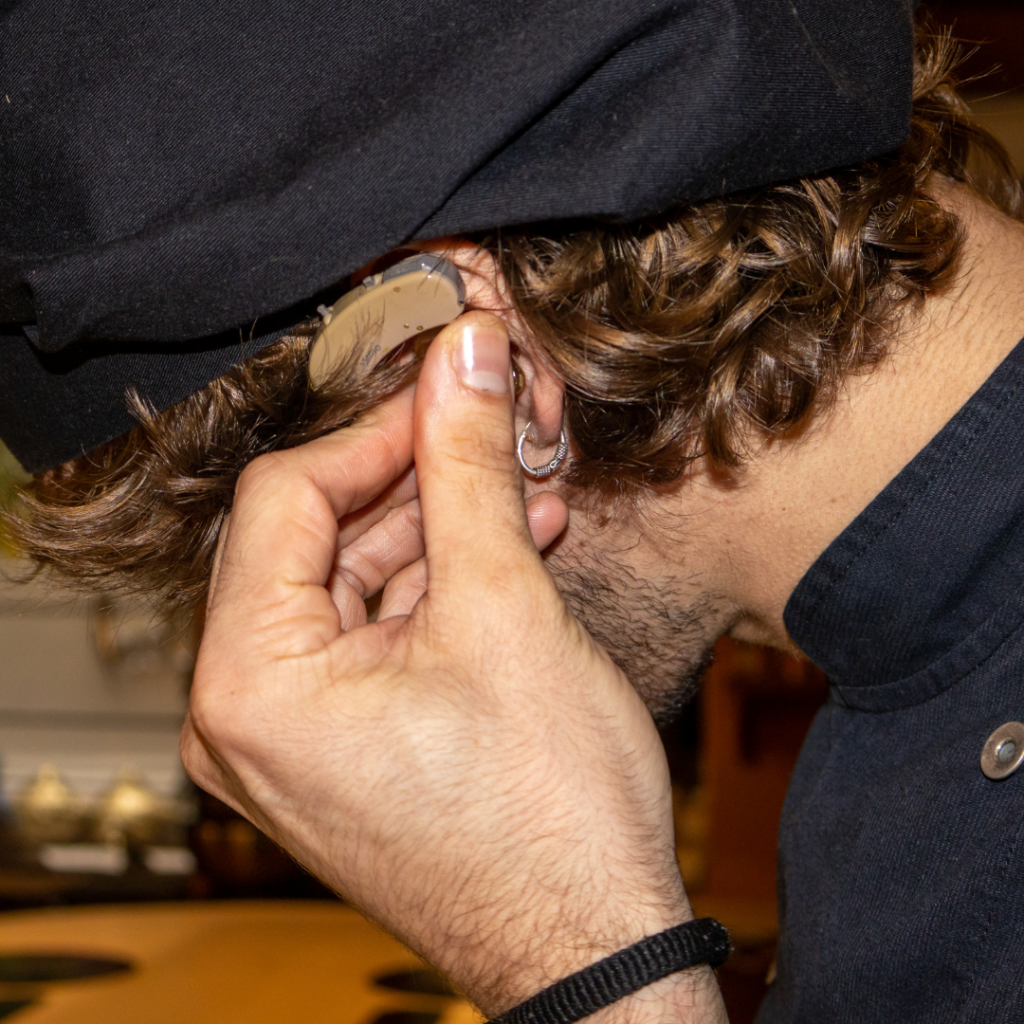
Following dinner conversations becomes challenging when high ambient noise interferes with your focus and hearing. Our audiology clinic conducts specialized testing to evaluate hearing in both quiet sound booths and noisy simulations to isolate the underlying cause. Once we determine the cause of difficult hearing, we can help you find personalized solutions.
Why Everyday Hearing Fails in Busy, Noisy Restaurants
Low-noise environments yield an advantageous signal-to-noise ratio where primary speech remains significantly louder than background sound. Modern restaurant environments create the complete opposite listening environment. Cross-talk, ambient music, dishware noise, and harsh acoustic reverberation interfere with speech clarity, forcing your brain to labor to extract the target voice.
These auditory struggles commonly accompany untreated high-frequency hearing loss, central processing delays, or presbycusis. Attention, fatigue, dim lighting, and distance from the speaker may make it worse. Numerous individuals show standard hearing thresholds on paper but reveal marked comprehension drops on clinical speech-in-noise testing. Consistent difficulty following restaurant conversation warrants clinical investigation even when everyday hearing seems largely unaffected.
Diagnostic Protocols for High-Frequency Hearing Loss
We begin by reviewing your history of communication difficulties, prior noise exposures, ringing or tinnitus, pharmaceuticals, and unilateral symptoms.
Through pure-tone audiometry, we determine your faintest auditory perception across low to high pitches utilizing both air and bone conduction testing. Patients with high-frequency hearing loss typically exhibit a sloping audiogram configuration where sensitivity steadily declines at elevated pitches. Supplementary assessments routinely include diagnostic tympanometry to analyze middle-ear status alongside word-recognition testing to determine speech clarity.
A quiet sound booth cannot replicate complex dining room acoustics, which makes clinical speech-in-noise testing especially informative. It evaluates sentence-level speech comprehension as competing background babble increases in volume. Together, these results show whether the problem involves audibility, speech clarity, background-noise processing, or a combination of factors.
How Auditory Processing Difficulties Impact Adult Hearing
A diagnosed auditory processing disorder affects how the brain’s auditory cortex analyzes, organizes, and interprets sound. The physical ear mechanisms may capture tones correctly, but the central brain pathways struggle to filter competing inputs, parse similar consonants, or interpret rapid speech. We prioritize assessing peripheral auditory acuity before recommending an in-depth central auditory-processing assessment or external medical referrals.
Actionable Listening Tips for Noisy Social Settings
Small changes can improve the signal reaching your ears and provide clearer visual cues. Prioritize dining at establishments designed with subdued acoustics or reserve tables during non-peak business hours. Venues with booths, acoustic panels, curtains, carpeting, and other sound-absorbing features may be easier than open rooms filled with hard surfaces.
While seated at the restaurant:
- Ask for seating positioned far away from open kitchens, noisy bar areas, ceiling speakers, and large parties.
- Position yourself with your back toward a solid partition to dampen intrusive background noise from behind.
- Position yourself directly opposite your companions where direct lighting highlights their facial expressions.
- Keep conversational proximity as close as comfortably feasible to preserve acoustic signal strength.
- Direct your better-performing ear toward the companion you most need to understand.
- Request that companions rephrase misunderstandings using different words rather than repeating the same sentence.
- Verifiably confirm essential conversational facts instead of bluffing comprehension.
- Step into a quiet area for a few minutes when listening fatigue begins to compromise focus.
- Request that dining partners articulate words distinctly at an unhurried, natural speed.
- Speaking with excessive volume creates acoustic distortion that fails to make words clearer.
Modern Audiological Tools for Managing Background Noise
Selecting the ideal assistive technology depends upon underlying diagnosis, specific acoustic challenges, and verified hearing loss. Professionally programmed hearing aids incorporate multi-channel directional microphones, digital noise reduction algorithms, and custom restaurant settings to capture frontal speech while attenuating background interference. They still require realistic expectations because no device can remove every unwanted voice.
Utilizing an external remote microphone can deliver a dramatically superior signal-to-noise ratio. The remote unit is attached to the speaker’s clothing or placed nearby, transmitting that voice straight into compatible hearing aids or an audio receiver. By streaming directly, this technology overcomes acoustic falloff from distance and surrounding environmental noise.
Other useful options include:
- Multi-directional table microphones designed for small dinner gatherings
- Telecoils or hearing-loop systems in equipped venues
- Mobile phone live-transcription apps offering real-time conversational subtitles
- Modern wireless hearables delivering directional beamforming and sound enhancement
- Decibel-monitoring apps and crowd-sourced dining platforms that track restaurant noise
Our audiology staff helps you evaluate options, ensures wireless compatibility, and trains you on operating your chosen equipment.
The Clinical Role of Audiologists in Managing Loud Environments
A comprehensive hearing evaluation looks far beyond the common misconception of “I hear fine in quiet environments.” We assess the specific acoustic settings, speaker dynamics, and volume levels that disrupt your hearing to administer targeted evaluations. Your comprehensive workup may involve pure-tone hearing thresholds, middle-ear testing, recorded word recognition, and speech-in-noise measures. Diagnostic auditory-processing testing may be recommended if your clinical symptoms and baseline evaluations suggest central auditory dysfunction.
Any sudden, asymmetric, or rapidly deteriorating hearing loss demands immediate medical evaluation by an ear, nose, and throat physician. Comprehensive clinical care targets the physiological roots of hearing difficulties rather than simply writing them off as bad restaurant acoustics.
Request an Audiology and Hearing Evaluation Today
If restaurant conversations leave you guessing, withdrawing, or feeling exhausted, schedule a comprehensive hearing evaluation with us. We provide proven treatments to enhance your hearing in noisy environments, offering hearing aid fine-tuning, specialized assistive accessories, and individualized auditory therapy.
Contact our practice today to book your consultation and take a decisive step toward reconnecting in social settings.